
Estate coordination
Trusts, wills, and estate planning -- general education
Why documents, beneficiaries, and incapacity planning matter for retirement households. NFI Retirement Academy does not provide legal advice or create legal documents. A qualified estate-planning attorney should guide document choices for your state and family.
Why estate coordination matters in retirement
Retirement is when many families first feel the weight of: who inherits, who decides if you cannot, how retirement accounts pass, and whether probate will slow or publicize transfers. Insurance and investment decisions often need to coordinate with legal documents -- they do not replace them.
Map who decides and who inherits
Will / trust intent, plus incapacity decision-makers.
Align beneficiary forms and titling
IRAs, 401(k)s, and life insurance often pass by form -- not by will language alone.
Meet a qualified attorney
State law, funding steps, and family facts decide documents -- not a webpage.
Will vs. revocable living trust
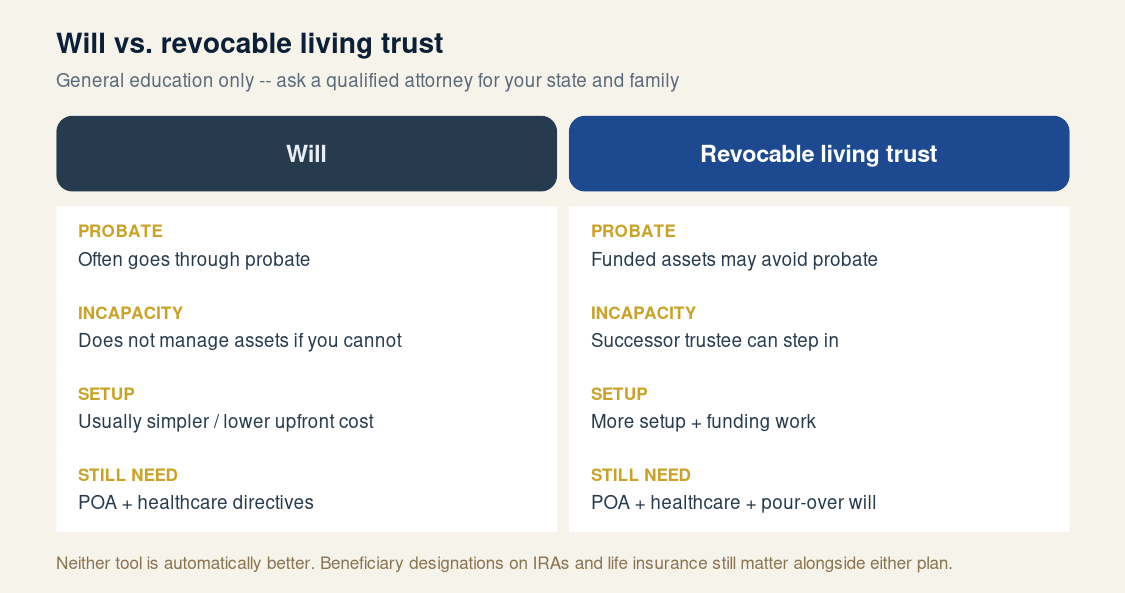
| Topic | Will | Revocable living trust |
|---|---|---|
| Probate | Often goes through probate for probate assets | Funded assets may avoid probate (state/fact specific) |
| Incapacity | Does not manage assets if you cannot | Successor trustee can step in when funded |
| Setup | Usually simpler / lower upfront cost | More setup + funding work |
| Still need | POA + healthcare directives | POA + healthcare + pour-over will often |
Wills
A will states how probate assets should be distributed and can name guardians for minor children. Without a valid will, state intestacy rules decide. A will alone does not avoid probate for assets that must pass through the probate process.
Revocable living trusts (concept)
A revocable living trust is a legal arrangement you can typically change during life. Assets titled in the trust may avoid probate at death (subject to proper funding and state law). Trusts can also help with incapacity management when successor trustees are named. They involve setup cost, funding work, and ongoing attention -- not automatically "better" than a will for every family.
Common reasons families discuss trusts with an attorney
- Desire to avoid or simplify probate for certain assets
- Blended families and unequal or staged distributions
- Privacy preferences
- Planning for a beneficiary who may need oversight
- Coordination with incapacity planning
- Multiple properties or accounts across states
Probate -- plain English
Probate is the court-supervised process of validating a will (if any), paying valid debts, and transferring probate assets. It can take time and involve fees and public filings. Non-probate transfers (beneficiary designations, some jointly titled assets, properly funded trusts) may pass outside probate -- details are state- and fact-specific. Prefer your state court self-help or state bar consumer materials for local rules.
Powers of attorney and healthcare directives
- Financial power of attorney -- who can manage finances if you cannot
- Healthcare power of attorney / proxy -- who can make medical decisions
- Living will / advance directive -- your preferences for end-of-life care
These documents address incapacity during life -- a gap a will alone does not fill.
Beneficiaries, titling, and retirement accounts
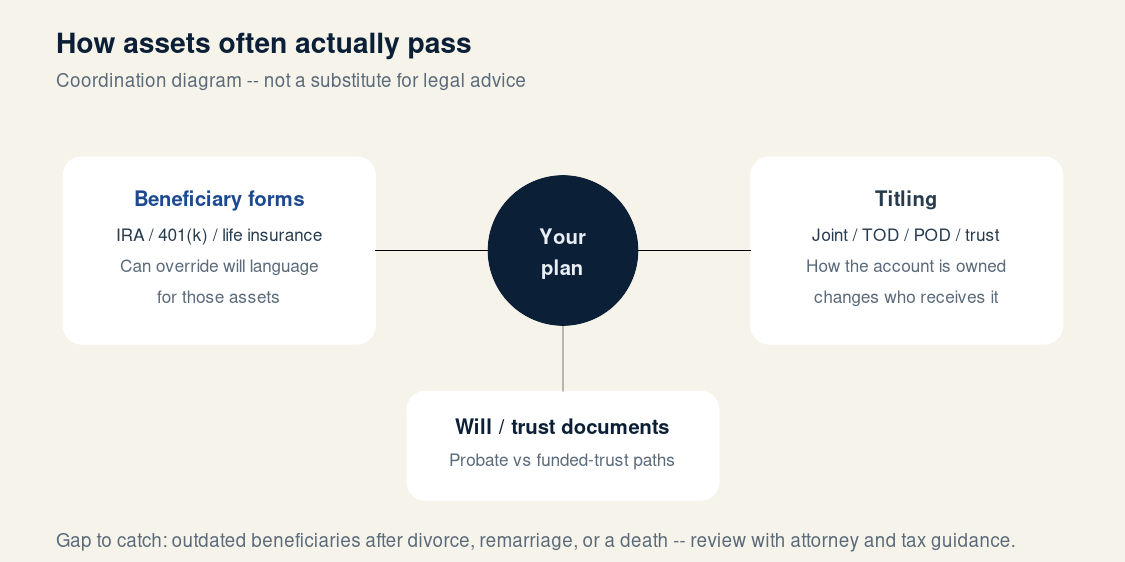
IRAs, 401(k)s, and life insurance often pass by beneficiary designation, which can override will language for those assets. Review designations after marriage, divorce, births, and deaths. Account titling (individual, joint, TOD/POD where available) also affects who receives assets. Coordinate designations with the overall estate plan -- with attorney and tax guidance. IRS materials on retirement account beneficiary distributions are useful for tax education, not personalized advice.
Life insurance coordination (high level)
Life insurance can provide liquidity for estate expenses, replace income for a survivor, or equalize inheritances. Ownership and beneficiary design matter; advanced trust ownership structures (such as an ILIT) are attorney-led topics beyond this page.
Potential benefits of organized documents
- Clearer instructions for family and fiduciaries
- Fewer surprises about who inherits retirement accounts
- Better incapacity readiness
- Cleaner coordination with insurance and income plans
Tradeoffs
- Legal fees and time to create and update documents
- Trusts require funding -- an unfunded trust may not achieve its purpose
- Overly complex plans can confuse families
- Tax outcomes are not guaranteed by any webpage summary
Who may / may not need a trust conversation
Often worth an attorney visit
- Homeowners with multiple accounts and beneficiaries
- Blended families
- Concerns about probate timing or privacy
- Desire for incapacity continuity
Still need basics even if...
- You think "everything is joint" -- beneficiary and incapacity gaps remain common
- You found an online form -- state law and funding details still matter
Questions to ask a qualified estate-planning attorney
- For our state and family, is a will-based plan enough or should we consider a revocable trust?
- How should IRA and life insurance beneficiaries align with the will or trust?
- What incapacity documents do we need, and who should serve?
- What must we do after signing to keep the plan effective (funding, retitling)?
- When should we review the plan again?
Sources and further reading
- American Bar Association (RPTE) â Estate Planning Information & FAQs (not legal advice): https://www.americanbar.org/groups/real_property_trust_estate/resources/estate-planning/
- ABA RPTE â Revocable trusts: https://www.americanbar.org/groups/real_property_trust_estate/resources/estate-planning/revocable-trusts/
- Consumer Financial Protection Bureau â Managing someone elseâÂÂs money (POA / trustee / guardian guides): https://www.consumerfinance.gov/consumer-tools/managing-someone-elses-money/
- CFPB / FDIC â Money Smart for Older Adults: CFPB hub ÷ FDIC hub
- IRS â Estate tax overview (federal tax basics only): https://www.irs.gov/businesses/small-businesses-self-employed/estate-tax
- IRS Publication 559 â Survivors, Executors, and Administrators: https://www.irs.gov/publications/p559
- IRS Publication 590-B â IRA distributions (beneficiary education; not tax advice): https://www.irs.gov/publications/p590b
- USA.gov â Courts (includes probate for wills and estates): https://www.usa.gov/courts.
- USA.gov â Dealing with the death of a loved one: https://www.usa.gov/death-loved-one
- USA.gov â Find legal aid / a lawyer: https://www.usa.gov/legal-aid. Wills, trusts, probate, and powers of attorney are governed by state law, which varies â work with a licensed estate-planning attorney in your state.
- Cross-link: Retirement income planning and Long-term care planning.
General education only â not legal advice. For wills, trusts, and related documents, consult a licensed estate-planning attorney in your state.