
Health-related risks
Long-term care: the cost risk families often overlook
A calm look at why care costs can reshape a retirement plan, what Medicare does and does not cover, and strategy categories -- traditional, hybrid, self-fund, and family plans.
Why it matters
Long-term care (help with daily activities such as bathing, dressing, or supervision for cognitive impairment) is different from hospital care. Costs can run for months or years and are often paid from savings, family time, or specialized insurance -- not from ordinary Medicare the way many people assume.
Not every person will need years of paid care. The planning point is risk management: a minority outcome can still be financially severe. Plan for the possibility; do not plan from panic.
Medicare is not long-term care insurance
Medicare may cover limited skilled care under specific conditions (for example, after a qualifying hospital stay, for a limited time). It is generally not designed to pay for ongoing custodial care at home or in assisted living the way LTC insurance or personal funds might. Medicaid may help people who meet strict income and asset rules -- often after spending down resources. Rules are complex and state-specific; verify with official sources and a professional. See Medicare.gov on long-term care.
Official Medicare.gov pages linked in Sources.
Family caregiving is part of the real cost
Unpaid care by spouses and adult children has economic and health costs: lost wages, burnout, and strained relationships. A plan that only looks at insurance premiums misses the family labor question. Discuss preferences early: who would help, what is realistic, and what paid care would be acceptable.
Dementia and cognitive considerations
Some long-term care needs involve cognitive impairment or dementia -- including supervision, safety, and decision-making support -- not only help with physical daily activities. Benefit triggers on many policies include cognitive criteria as well as activities of daily living (ADLs). Planning conversations should cover: who can make decisions if capacity declines, how housing and supervision would work, and whether any coverage being considered addresses cognitive triggers. This is planning language, not a prediction that any person will develop dementia.
Strategy categories (educational menu)
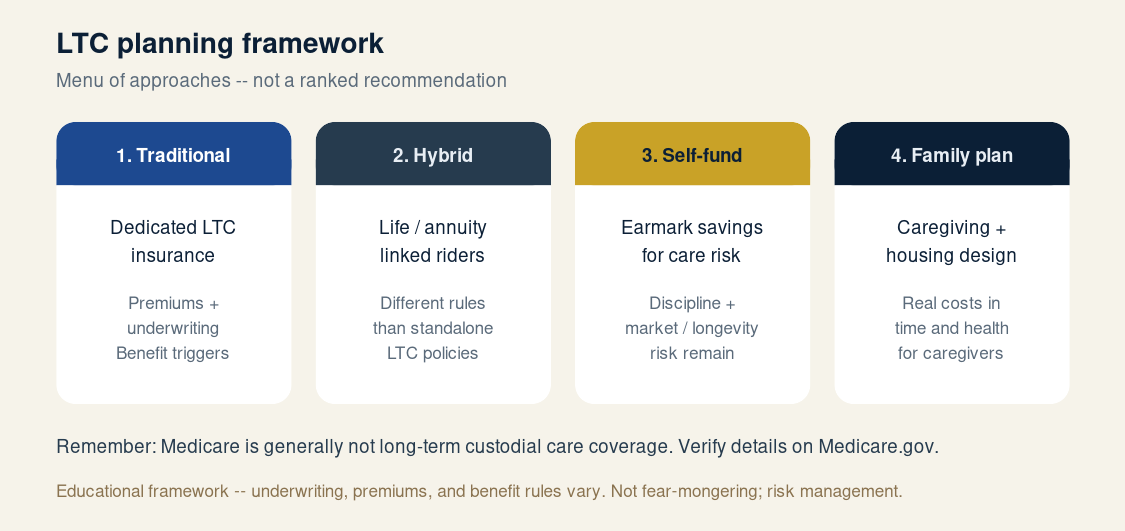
Traditional LTC insurance
Dedicated policy paying benefits when you meet benefit triggers (often ADL or cognitive criteria). Tradeoffs: premiums, underwriting, possible rate increases on some designs, "use it or risk feeling you paid for unused coverage."
Hybrid / linked approaches
Life insurance or annuity designs with chronic-illness or LTC-style riders. Tradeoffs: cost of riders, benefit rules, impact on death benefit, complexity. Not identical to standalone LTC.
Self-funding
Earmark investments or cash for potential care. Tradeoffs: markets and longevity can collide; family may still bear caregiving load; requires discipline not to spend the earmark.
Family / housing plan
Shared housing, paid family caregivers, or community resources. Tradeoffs: relationships, capacity, and uneven burden among siblings.
Potential benefits of planning ahead
- Clearer funding source if care is needed
- Less forced liquidation of retirement assets at a bad time
- More choice about setting of care
- Honest family conversations before a crisis
Tradeoffs
- Premiums and opportunity cost of capital set aside
- Underwriting -- coverage is not automatic
- Benefit triggers, elimination periods, and inflation riders add complexity
- Self-funding can fail if costs exceed reserves
- No strategy eliminates emotional difficulty of care decisions
Who may / may not fit formal coverage
May explore coverage or hybrids
- Assets to protect from care costs but not unlimited wealth
- Family unable or unwilling to provide full unpaid care
- Insurable and able to afford premiums without strain
May emphasize other paths
- Very high net worth intentionally self-insuring with a written plan
- Unable to pass underwriting or afford premiums
- Near-term cash crisis where premiums compete with essentials
Questions to ask
- What would paid care cost in our area for in-home help vs. facility care?
- What does Medicare cover in our situation -- and for how long?
- If we buy coverage, what are benefit triggers, elimination period, and inflation options?
- How would a hybrid life/LTC design change our legacy goals?
- What is our family's realistic caregiving capacity?
Sources and further reading
- Medicare.gov -- Long-term care (custodial care not covered): https://www.medicare.gov/coverage/long-term-care.
- Medicare.gov -- Nursing home care / skilled nursing facility care (short-term skilled != LTC): nursing-home-care ÷ SNF care.
- Cross-link: Retirement income planning and Trusts and estate.