
Annuities literacy
What is a fixed indexed annuity?
A plain-English look at what an FIA is -- and what it is not -- including how interest is credited, why zero-crediting periods happen, liquidity tradeoffs, tax deferral basics, and how income riders differ from cash value.
The question people actually ask
"I keep hearing about fixed indexed annuities. Are they like a bank CD? Like the stock market? Or something else?"
They are something else: an insurance contract with an insurer. Interest credited for a period can be linked to the performance of a market index -- subject to contract rules such as caps, participation rates, and spreads -- while typically protecting the contract from direct market losses for that crediting method, subject to contract terms and the insurer's claims-paying ability.
What an FIA can do
- Credit interest using index-linked rules
- Apply a period floor on many strategies (often 0%)
- Optionally support lifetime income via riders
What an FIA is not
- Not a bank CD or FDIC-insured deposit
- Not owning the stock market or index fund
- Not unlimited upside -- caps/participation/spreads limit credited interest
Why it matters
Many people near or in retirement want growth potential without putting every dollar at the mercy of a market drop. FIAs are one product family designed around that tension. Understanding the mechanics helps you evaluate marketing claims, compare contracts, and decide whether deeper discussion is worthwhile.
- Not a bank account or CD. It is not FDIC-insured. Guarantees depend on the issuing insurer.
- Not a market investment. You do not own the index, the stocks in it, or an index fund -- and you typically do not receive dividends. (FINRA / NAIC consumer materials describe indexed annuities as insurance products with index-linked interest.)
- Not unlimited upside. Caps, participation rates, and spreads intentionally limit how much index-linked interest can be credited in a period.
- Not universally "safe." Liquidity limits, opportunity cost, rider fees, and insurer credit risk still matter.
How index-linked crediting works
In simple terms:
- You allocate premium to one or more crediting strategies in the contract.
- Over a period (often one year), a named index moves up or down.
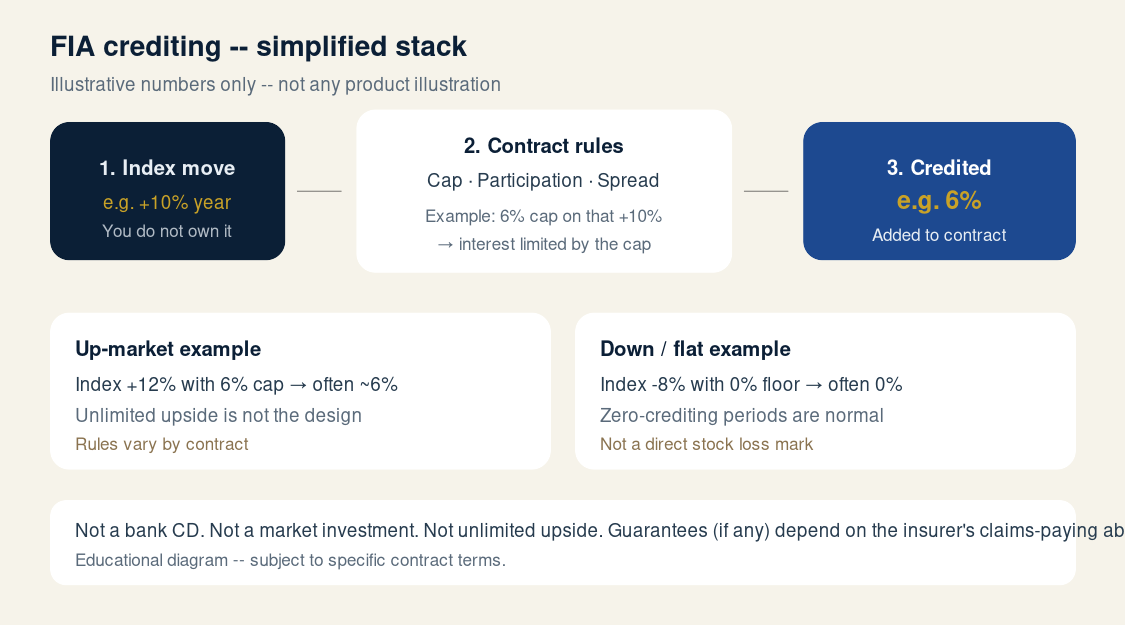
- The insurer applies contract rules -- commonly a cap, participation rate, and/or spread -- to calculate interest credited for that period.
- Many strategies include a floor (often 0% for the period), so a negative index move typically does not produce negative credited interest for that method -- again, subject to the specific contract.
Caps, participation rates, and spreads
- Cap
- An upper limit on the interest rate that can be credited for the period. If the index rises 12% and the cap is 6%, credited interest for that strategy is often limited to 6% (rules vary).
- Participation rate
- The percentage of the index gain used in the calculation. A 50% participation rate on a 10% index gain may credit about 5% before other adjustments.
- Spread (or margin)
- An amount subtracted from the index gain before crediting. A 10% gain with a 2% spread may credit about 8%, subject to other rules.
If the index is flat or down, or if a small gain is reduced to zero by a spread or other rule, you may receive 0% credited interest for that period. That is how many FIA strategies behave -- not a "broken" product.
Bottom line on upside: FIAs are not designed to match full uncapped index or mutual-fund returns. The trade for structured downside rules on many methods is limited upside -- not unlimited market participation.
Principal protection -- careful wording
Marketing often says "protected from market losses." A clearer educational statement is:
Many FIA crediting methods are designed so that a decline in the linked index does not reduce the contract value through that index method for the period -- subject to contract terms. Separately, withdrawals, surrender charges, rider fees, and other contract features can still reduce value. And any contractual promise depends on the insurer's claims-paying ability.
Liquidity, surrender charges, and free withdrawals
FIAs are typically designed as longer-term contracts. Common features to understand:
- Surrender charge schedule -- leaving early can reduce what you receive
- Free withdrawal percentage -- limited annual access without full surrender charge
- Market value adjustment (MVA) -- some contracts adjust surrender values
- RMDs -- qualified contracts still follow IRS RMD rules where applicable
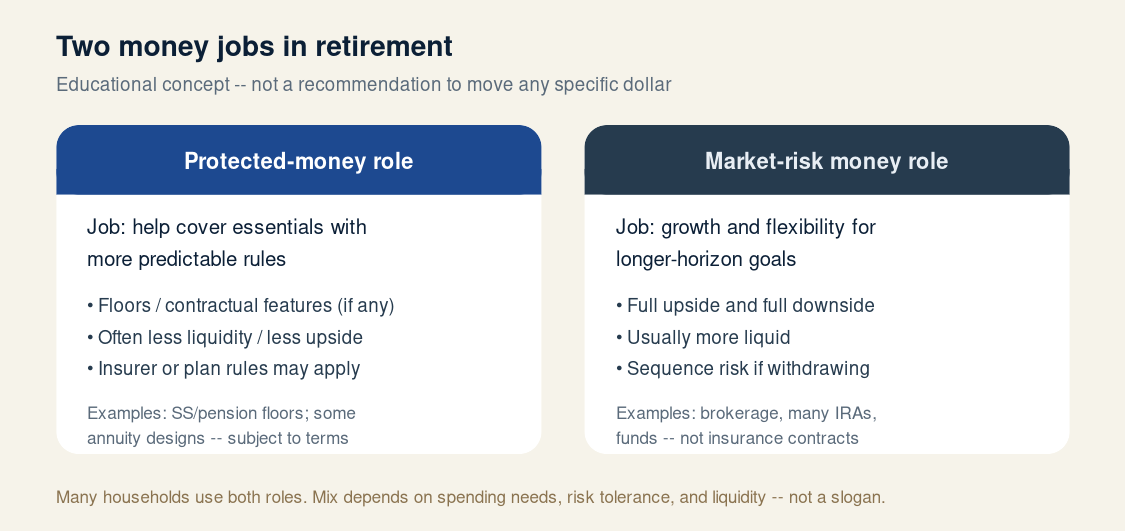
If you may need large, uncertain access to the money soon, locking a large share into a long surrender schedule may not fit. Protection features and liquidity limits travel together -- balanced education requires both.
Income riders and the three numbers people confuse
Some FIAs offer optional guaranteed lifetime withdrawal benefit (GLWB) or similar riders for a fee. These can create a contractual income stream under stated conditions -- they are not the same thing as your cash surrender value.
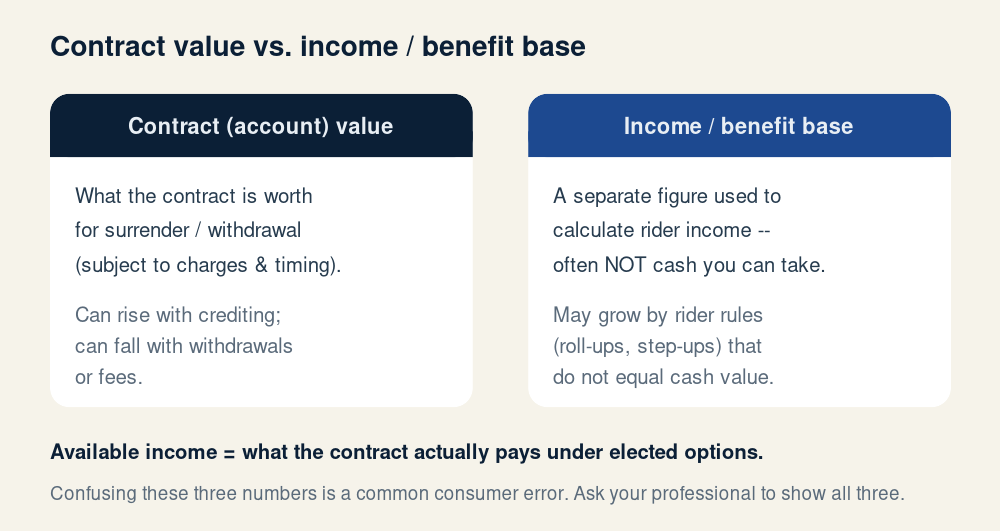
- Contract (account) value -- what you might surrender or withdraw (subject to charges and timing).
- Income / benefit base -- often a separate calculation base for rider income; frequently not withdrawable as cash.
- Available income -- what the rider actually pays under elected options and timing rules.
Joint-life income options can continue payments for a surviving spouse under rider terms. Beneficiaries may receive a death benefit defined by the contract (often related to contract value or a stated minimum) -- not automatically the benefit base.
Cross-read: How lifetime income works.
Tax concepts (general education â not tax advice)
This summary describes general federal income tax concepts that often apply to annuity contracts. It is not tax, legal, or financial advice for any individual. Rules can depend on the type of contract, when it was purchased, how money is taken out, and your personal situation. Exceptions and special rules may apply. For your own situation, consult a qualified tax professional or the IRS publications listed in Sources. Insurer surrender charges and state taxes are separate from federal income tax rules.
Tax deferral
Inside many deferred annuity contracts, earnings generally are not taxed as they grow. Federal income tax on those earnings typically applies when money is withdrawn or when annuity payments begin. Tax deferral does not mean the earnings are never taxed.
- Withdrawals before annuity payments begin (typical nonqualified): For a typical nonqualified commercial annuity bought with after-tax money, withdrawals are generally treated as coming from earnings first. Taxable earnings are usually taxed as ordinary income (not as long-term capital gain). Your Form 1099-R from the payer reports the distribution.
- Earnings vs basis: Your basis (investment in the contract) is generally the after-tax amount you paid in, reduced by amounts previously recovered tax-free. For most nonqualified deferred annuities purchased after August 13, 1982, non-annuity withdrawals before the annuity starting date are allocated first to earnings, then to basis. (Contracts with preâÂÂAugust 14, 1982 investment may follow a different ordering for that older investment; see Pub. 575.)
- Additional tax before age 59ý: If you receive a taxable distribution from an annuity before age 59ý, federal law may impose an additional 10% tax on the taxable portion, unless an exception applies. This is separate from ordinary income tax and from any insurer surrender charge. Exceptions are limited and fact-specific (see Pub. 575 / Form 5329); do not assume IRA/401(k) exceptions automatically apply to nonqualified annuities.
- When you annuitize: Once regular annuity payments begin under a nonqualified contract, taxation generally splits each payment into a tax-free return of investment and a taxable earnings portion under the IRS General Rule / exclusion ratio (Pub. 939). If the annuity starting date is after 1986, total exclusions generally cannot exceed your net cost; later payments are generally fully taxable after basis is recovered.
- Qualified vs nonqualified: Qualified annuities (IRA / plan wrappers) follow that planâÂÂs contribution and distribution rules; periodic payments from many qualified plans use the Simplified Method (Pub. 575), not the General Rule. Always identify whether a contract is qualified or nonqualified before applying these summaries.
Industry context: why FIA interest is high
LIMRA reported fixed indexed annuity sales of $30.7 billion in Q2 2026 (up 14% from Q1 2026; 7% below Q2 2025), within a record $123.9 billion total U.S. annuity market that quarter. That explains attention -- not personal suitability. Full context: Myths and facts -- sales myth.
Potential benefits (when a design fits)
- Index-linked crediting potential with a period floor on many strategies
- Partial separation from direct equity market losses for covered methods
- Optional lifetime income features via riders (with costs and rules)
- Possible role as one "bucket" alongside Social Security, pensions, and liquid reserves
Tradeoffs (required reading)
- Caps / participation / spreads limit upside vs. owning the market directly
- Zero-crediting periods can last through flat or down markets
- Surrender charges and limited liquidity
- Rider fees reduce net growth or income efficiency
- Complexity -- statements and illustrations need careful explanation
- Insurer credit risk; diversification of carriers can matter for large amounts
- Opportunity cost if you later wish you had stayed fully liquid or fully invested
Who may / may not fit
May be worth exploring
- People who want some growth potential with structured downside rules on a portion of assets
- Those who can leave money for the surrender schedule
- Households considering optional lifetime income features after comparing costs
- Those who understand FIAs are insurance contracts, not bank products
May not fit
- Need for high near-term or uncertain liquidity
- Desire for uncapped market participation and willing to accept full downside
- Unwillingness to accept insurer credit risk or product complexity
- Anyone told "everyone needs an FIA" without a needs and tradeoff discussion
Questions to ask
- What are the current caps, participation rates, and spreads -- and can they change?
- What is the surrender schedule and free-withdrawal amount?
- If there is an income rider, what does it cost, and how do contract value, benefit base, and income differ?
- What happens on death for me and for a joint owner/spouse?
- How does this fit with my emergency reserves, Social Security, and other accounts?
- What is the insurer's financial strength, and how concentrated would I be?
Sources and further reading
- Investor.gov (SEC) -- Annuities literacy (types, tax-deferred growth, fees, surrender, free-look, FIA vs RILA/VA). investor.gov/.../annuities. Balanced tradeoffs: FIAs limit upside; guarantees depend on insurer claims-paying ability.
- NAIC Buyer's Guide for Deferred Annuities -- tax deferral and product-type education: NAIC PDF. Also fixed deferred guide: fixed guide.
- FINRA -- Annuities investor overview (fixed vs variable vs indexed; tax deferral high-level): finra.org/.../annuities. Indexed complexity insight: FINRA indexed annuities.
- IRS Pub. 575 â Pension and Annuity Income: https://www.irs.gov/publications/p575 (nonqualified earnings-first withdrawals; early-distribution additional tax overview).
- IRS Pub. 939 â General Rule for Pensions and Annuities: https://www.irs.gov/publications/p939 (exclusion ratio for nonqualified annuitized payments).
- IRS Topic 410 / 411: Topic 410 ÷ Topic 411. Form 5329 overview: about Form 5329.
- LIMRA Q2 2026 sales context ($123.9B total; FIA $30.7B): LIMRA release. Demand != suitability.
- Contract prospectus / disclosure for any specific product under consideration.