
Retirement income
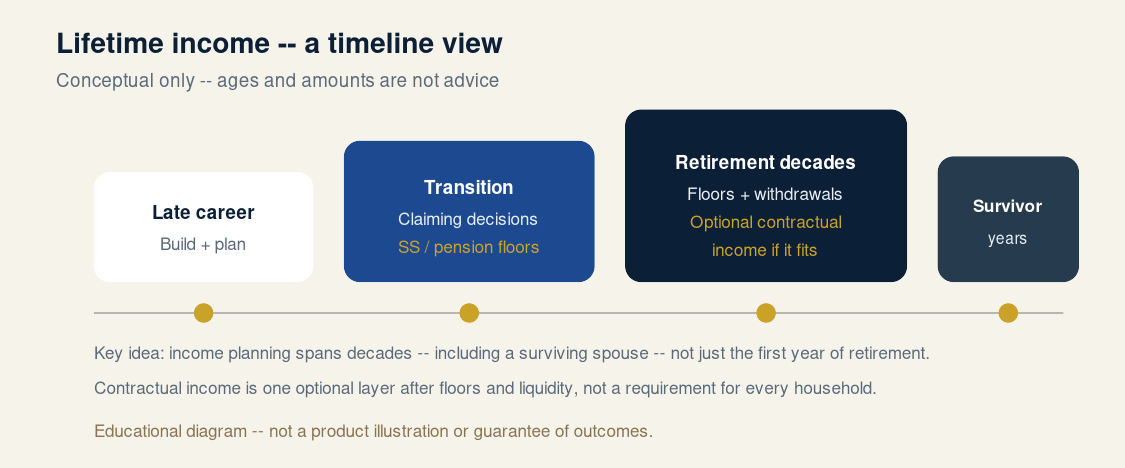
How lifetime income works
Retirement confidence is not only "How much money do I have?" It is also "How much can I comfortably spend while maintaining income throughout retirement?"
Why it matters: longevity and spending confidence
Longevity risk is the chance of living longer than planned -- and outliving savings or cutting spending sharply late in life. Related realities:
- Fear of outliving savings
- Underspending despite assets because income feels uncertain
- Confusion between a portfolio balance and a paycheck-like income stream
- Social Security and pensions as partial floors that may not cover the lifestyle you want
Sequence-of-returns risk
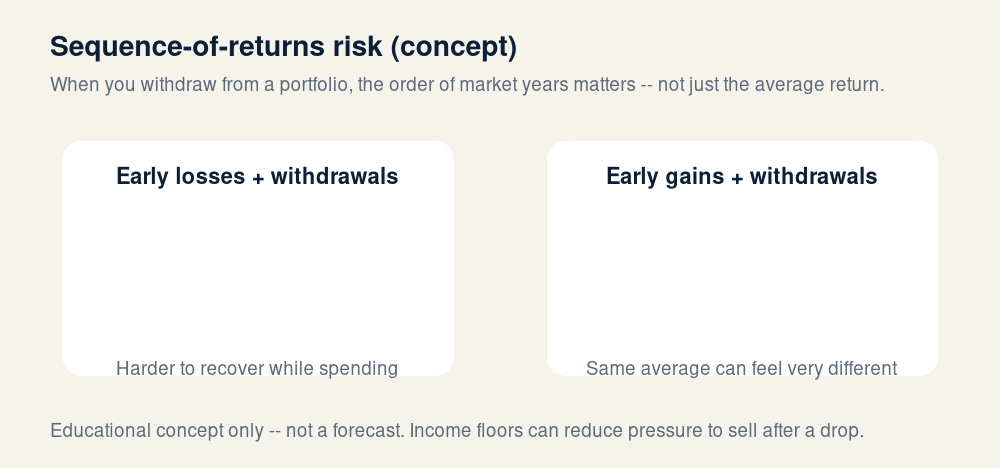
When retirement income depends on selling investments, the order of good and bad market years matters. Early losses plus withdrawals can shrink the portfolio faster than the same average return with better early years.
Strategies that can support lasting income
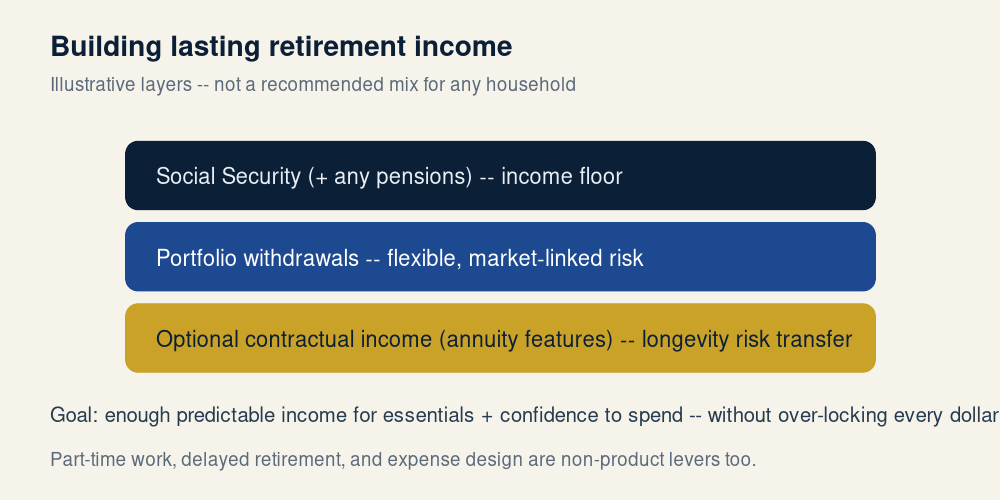
- Social Security claiming education â foundational U.S. inflation-adjusted income (SSA retirement benefits)
- Pensions (if any) â legacy lifetime income
- Systematic portfolio withdrawals â flexibility; market and longevity risk retained
- Annuities / income riders â transfer some longevity risk to an insurer (product-specific; liquidity and cost tradeoffs apply)
- Joint lifetime income â surviving spouse continuity
- Part-time work, delayed retirement, expense design â non-product levers
Do not hear: everyone needs an annuity. Do hear: for some people, converting part of assets into contractual income may improve planning confidence after tradeoffs.
Why are Americans looking at annuities? (industry context)
Q2 2026 U.S. annuity sales -- market context only
According to LIMRA, total U.S. annuity sales reached a record $123.9 billion in the second quarter of 2026 (up 4% year over year) -- the 11th consecutive quarter above $100 billion. First-half 2026 sales were $231.3 billion (a first-half record). Fixed indexed annuity sales were $30.7 billion in Q2 2026 (up 14% from Q1 2026; 7% below Q2 2025). SPIA sales set a quarterly record of $4.0 billion.
LIMRA's survey represents about 84% of the U.S. annuity market; beginning with the January 2026 report, LIMRA defines sales as all money paid into an individual annuity (new and existing contracts), including internal transfers/exchanges per LIMRA's note (excluding auto-renewals and products that trigger a surrender).
Record demand answers "why are people looking?" It does not prove an annuity is suitable for you.
Income riders -- overview
Optional riders on some deferred annuities can create lifetime withdrawal features for a fee, with rules about timing, amounts, and what happens on excess withdrawals. Contract value, benefit base, and available income are different numbers -- see the FIA guide.
Research built in: NBER Working Paper 35082
Discovery conversations sometimes mention longevity research popularized by industry speakers. For public education, NFI Retirement Academy cites the original academic source â not secondary marketing restatements:
Recent NBER research using data from nearly 600,000 Chilean retirees examined whether choosing lifetime annuity income rather than phased withdrawals affected longevity and reported evidence of lower mortality among retirees induced into annuitization by the studyâÂÂs research design. This is a 2026 NBER working paper (WP 35082) about ChileâÂÂs pension payout system. It is not proof that buying an annuity will make an individual U.S. retiree live longer, and it is not a reason to purchase any specific product. Guaranteed lifetime income can still be valued for income security and longevity-risk management.
Important caveats for readers
- This is an NBER working paper (not yet a peer-reviewed journal publication). Results can be revised; views are the authorsâÂÂ, not necessarily NBERâÂÂs.
- Results apply to ChileâÂÂs DC payout system and to a particular group of âÂÂcompliers,â and should not be assumed to apply automatically to U.S. retirees or to U.S. annuity products.
- Guaranteed lifetime income can still be valued for income security and longevity-risk management; this study is not proof that âÂÂbuying an annuity makes you live longer,â and it is not a reason to purchase any specific product.
- Predictable income may relate to spending confidence, stress, and willingness to use assets â educational interpretation only, not medical advice.
DOI: https://doi.org/10.3386/w35082 ÷ NBER page: nber.org/papers/w35082
Potential benefits
- Clearer answer to "how much can I spend?" when part of income is contractual
- Partial transfer of longevity risk
- Possible reduction in fear-driven underspending
- Spousal protection via joint-life designs
Tradeoffs
- Reduced liquidity / surrender constraints
- Inflation exposure if income is fixed nominal
- Rider costs and complex rules
- Account value vs. benefit base confusion
- Insurer claims-paying ability
- Bequest / legacy tradeoffs if heavily annuitized
- Research limits: working paper; Chile sample; not medical advice
Who may / may not fit
May explore
- Anxiety about outliving savings despite assets
- Underspending for lack of a paycheck-like floor beyond SS
- Couples wanting joint lifetime income
- Willingness to trade some liquidity on a portion of assets
May not fit
- High near-term liquidity needs
- SS + pension already cover essentials and remaining goals favor flexibility
- Unwillingness to accept insurer credit risk
Questions to ask
- What essential expenses should be covered by predictable income?
- How would a bad market decade in early retirement affect my withdrawals?
- If we use an income rider, what are the fees and the three key numbers?
- How should joint vs. single-life options affect a surviving spouse?
Sources and further reading
- Larrain, B., Previtero, A., & Severino, F. (2026). The Effect of Annuities on Longevity. NBER Working Paper 35082. https://doi.org/10.3386/w35082 ÷ NBER listing. ChileâÂÂs pension system differs from the U.S.; not proof an annuity extends an individual U.S. retireeâÂÂs life.
- LIMRA â U.S. annuity sales Q2 2026 record context: LIMRA release (Jul 27, 2026). Demand â suitability.
- Investor.gov â Annuities: investor.gov/.../annuities
- SSA â Retirement benefits: https://www.ssa.gov/benefits/retirement/
- SSA â Full retirement age: https://www.ssa.gov/benefits/retirement/planner/ageincrease.html
- SSA â Early claiming / benefit reduction: https://www.ssa.gov/benefits/retirement/planner/agereduction.html
- SSA â Delayed retirement credits: https://www.ssa.gov/benefits/retirement/planner/delayret.html
- SSA â Receiving benefits while working: whileworking.html
- SSA â Quick Calculator: oact/quickcalc
- SSA â Survivor benefits: https://www.ssa.gov/benefits/survivors/
- Optional â SSA OACT longevity: https://www.ssa.gov/OACT/population/longevity.html
- Cross-link: Retirement income planning, FIA guide, Myths and facts.