
Protection concepts hub
Protecting retirement assets — a map of the decisions
Protected money vs. market-risk money, sequence risk, income floors, long-term care cost risk, and fixed indexed annuity literacy — connected in one place so you can choose where to go deeper.
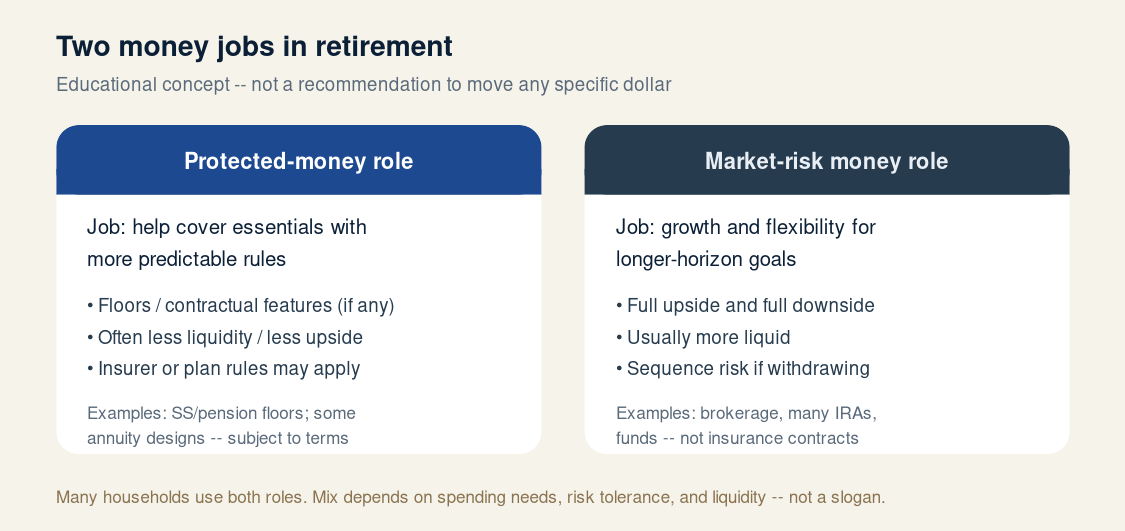
Protected money and market-risk money
Working years often treat “the portfolio” as one pile. Retirement spending works better when dollars have jobs:
Protected / more predictable roles
Dollars meant to cover essentials with clearer rules — Social Security, pensions, cash reserves, and (when they fit) insurance-based contractual features. Protection is never absolute; insurer and contract terms matter.
Market-risk / growth roles
Dollars that seek long-term growth and flexibility with full upside and downside. Useful for longer horizons and discretionary goals — stressful if they must fund next year’s grocery bill after a drop.
Sequence risk — why early losses hurt retirees differently
Withdrawing after early market losses can permanently damage a plan even if long-run average returns look fine. That is one reason households discuss income floors and which dollars fund near-term spending.
Go deeper: Retirement income — sequence and longevity risks · Lifetime income — sequence section.
Income floors before product talk
Social Security (and any pension) creates a foundation. The gap between that floor and your essential spending is where portfolio withdrawals — and optionally contractual income tools — enter the conversation.
Start here: Retirement income planning · How lifetime income works.
Fixed indexed annuity literacy (when protection features are discussed)
Fixed indexed annuities (FIAs) are insurance contracts that can credit interest linked in part to an external index, typically with a floor against index losses for that crediting feature — subject to caps, participation rates, spreads, fees, riders, and surrender schedules. An FIA is not a stock-market investment and is not automatically suitable because industry sales are high.
Long-term care — a protection risk for assets and family
Care costs can force asset sales and unpaid family labor. Medicare is not designed as long-term custodial care insurance. Strategy categories include traditional LTC, hybrid/linked approaches, self-funding, and family/housing plans — each with tradeoffs.
Life insurance and estate coordination
Protection planning also includes survivor income, estate liquidity, and beneficiary alignment — legal documents and insurance designations must work together.
Potential benefits of a clear protection map
- Less confusion about which dollars fund which goals
- Better questions before moving money into long surrender schedules
- Honest tradeoff talk: over-protecting has opportunity cost too
Tradeoffs
- More contractual protection can mean less liquidity and market upside
- More market exposure can mean more sequence stress
- Insurance features involve costs, limits, and insurer claims-paying ability
- No webpage can size your buckets for you
Questions to ask
- What essential spending must be covered even in a bad market year?
- How many years of near-term spending should stay highly liquid?
- Which risks worry us more — market drops, longevity, care costs, or survivor income?
- Before any product discussion, do we agree on the job each dollar should do?
Sources and further reading
- Social Security Administration — Retirement benefits: https://www.ssa.gov/benefits/retirement/
- SEC Investor.gov — Asset allocation / diversification basics: Investor.gov publications hub · Asset allocation glossary
- FINRA — Asset allocation: https://www.finra.org/investors/investing/investing-basics/asset-allocation
- NAIC — Annuities consumer information: https://content.naic.org/consumer/annuities.htm
- Medicare.gov — Long-term care coverage limits: https://www.medicare.gov/coverage/long-term-care
- Cross-links: Retirement income, FIA literacy, Long-term care, Research and insights.